Ambiguity in state-owned land property rights increases transaction costs in China’s transit-oriented development projects
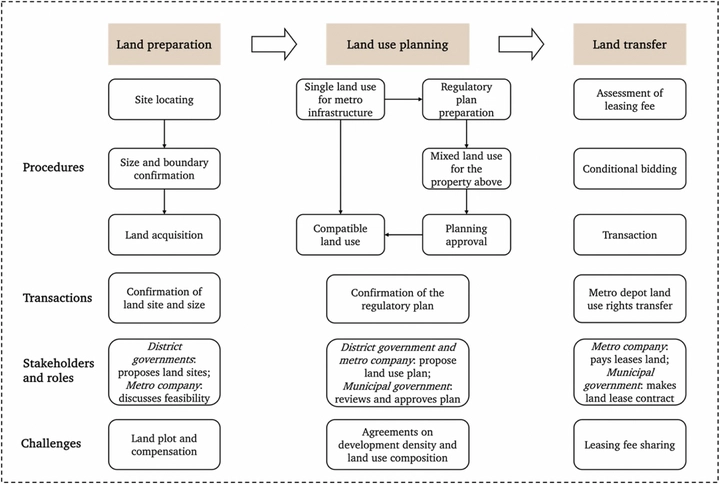 The analytical framework of land development of TOD projects in Guangzhou
Abstract
This paper provides compelling evidence that the ambiguity in state-owned land property rights increases transaction costs in China’s transit-oriented development (TOD) projects. The constitution defines the state as the de jure (legally defined) owner of urban land, but tiers of local government share the de facto (practically controlled) land property rights; this ambiguity complicates land use right transfer for TOD. Through expert interviews, document analysis, and case studies in Guangzhou, we identified three critical issues. First, ambiguity in de facto land property rights has led district governments to relocate the metro depot site from a profitable plot suitable for metro scheduling and property development to land plots that are less advantageous and far away from the station. Second, the coexistence of land allocation and leasing approaches under state ownership discouraged an optimised land assembly for the TOD project. Rigid acquisition sizes designated in land allocation for infrastructure discouraged coordination and prolonged negotiations between the district government and the metro company. Finally, the district government faced a disproportionate fiscal responsibility compared to their land leasing share from the municipal government. They are thus passively against the TOD project using their land use planning power. These transaction costs delay the TOD project and jeopardise the outcomes, resulting in depots far from metro stations, housing adjacent to industrial areas, and oversized commercial spaces on urban fringes. We argue that the ambiguity in state-owned land property rights is rooted in China’s historical, cultural, and institutional contexts, driving high transaction costs for urban infrastructure development.
Dr Dongsheng He
Research Fellow
Dr Dongsheng He advances sustainable urbanisation through integrated transportation and land use planning. His research explores strategies to promote active travel and implement transit-oriented development (TOD) as pathways to creating more liveable, low-carbon cities. His work has examined the mechanisms of land value capture in relation to TOD, identifying how municipalities can leverage this approach to finance expanded transit infrastructure while supporting broader sustainable development goals.

Dr Jinshuo Wang
Postdoctoral Fellow
Dr Jinshuo Wang is investigating institutional frameworks structuring urban rail investments in China’s Greater Bay Area. She examines how governance and financing influence transit-oriented development implementation through comparative policy analysis.
Dr Guibo Sun
Director
Dr Guibo Sun is a Lecturer in Urban Planning at the University of Manchester. His research examines how major urban infrastructure shapes cities and affects social and health outcomes, spanning the intersections of planning, land policy, transportation, urban design, and public health.