Measuring volumetric urban design: Compression, multi-level connectedness, and functional mix in transit-oriented developments in Hong Kong
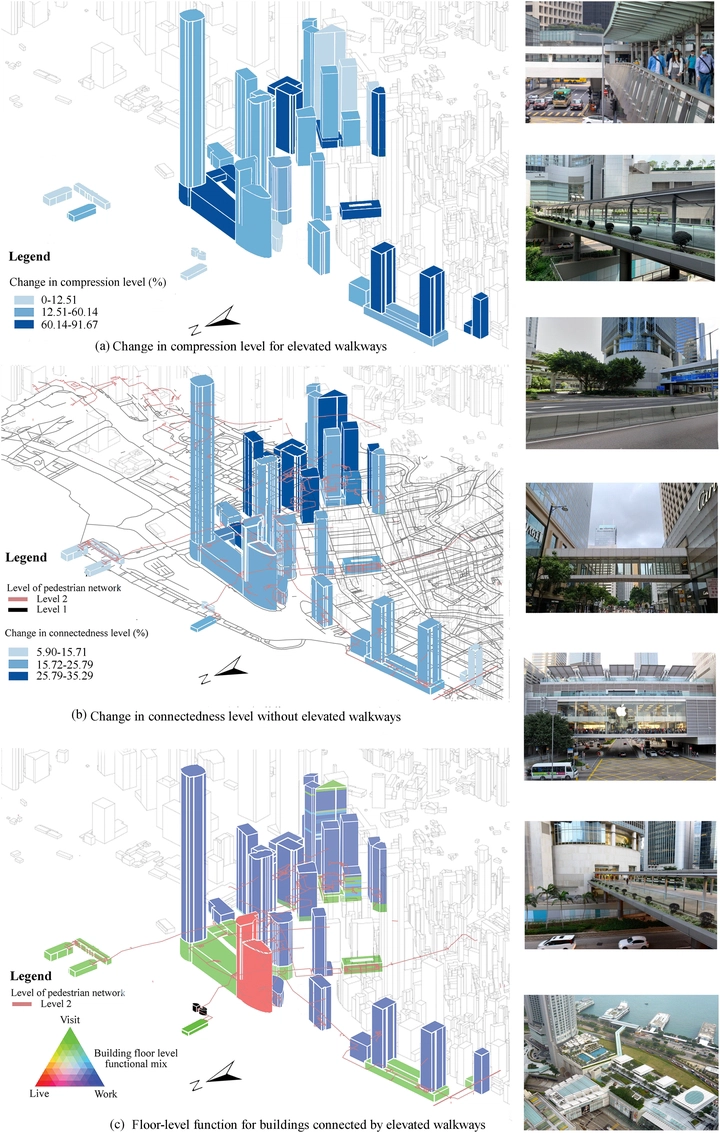 Contributions of elevated walkways to volumetric design outcomes
Abstract
High-density cities like Hong Kong are shaped by volumetric urban design, featuring three-dimensional pedestrian networks and integration of metro stations with property developments under transit-oriented development (TOD) principles. Conventional urban form metrics, which are largely two-dimensional, cannot capture these volumetric characteristics. This study addresses this limitation by developing quantitative metrics for three core elements of volumetric urban design: compression, multi-level connectedness, and functional mix. Drawing on high-resolution data on pedestrian networks, building data, and points of interest, we analyse case metro station areas in Hong Kong. The results show that 57% of buildings exhibit mixed use, characterised by pronounced functional stratification: employment- and visitor-oriented activities are concentrated within podiums, while residential uses dominate the upper floors. This vertical layering, encouraged by TOD principles, is accompanied by substantial spatial compression and high levels of multi-level pedestrian connectivity across buildings and transport nodes. In contrast, conventional two-dimensional measures fail to capture up to 91% of spatial compression and 52% of pedestrian connectedness, and systematically misclassify all buildings as mono-functional. By explicitly accounting for multi-level connectivity, intensified space use, and vertical functional mix—key hallmarks of volumetric cities—our approach proposes a transferable framework for measuring and analysing volumetric urban design. These findings have implications for urban analysis, urban design research, and planning policy, providing researchers and practitioners with robust tools for assessing high-density, multi-layered urban environments.
Dr Dongsheng He
Research Fellow
Dr Dongsheng He advances sustainable urbanisation through integrated transportation and land use planning. His research explores strategies to promote active travel and implement transit-oriented development (TOD) as pathways to creating more liveable, low-carbon cities. His work has examined the mechanisms of land value capture in relation to TOD, identifying how municipalities can leverage this approach to finance expanded transit infrastructure while supporting broader sustainable development goals.
Dr Guibo Sun
Director
Dr Guibo Sun is a Lecturer in Urban Planning at the University of Manchester. His research examines how major urban infrastructure shapes cities and affects social and health outcomes, spanning the intersections of planning, land policy, transportation, urban design, and public health.