The value-capture paradox of metro accessibility and gated communities in China
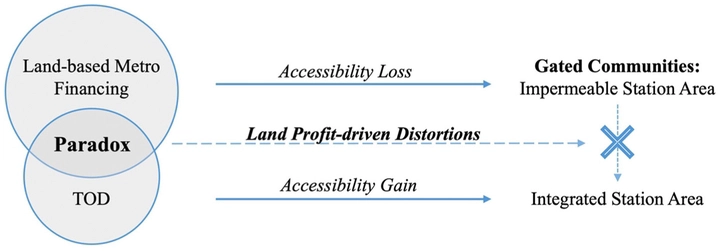 The capture value paradox in China’s metro projects.
Abstract
This paper highlights a critical challenge in China: although metro projects are justified by their potential to improve accessibility—a core public good—these benefits are often captured by private developers through the construction of gated communities around metro stations. We argue that local government’s reliance on land finance to cover the high costs of the infrastructure has distorted planning priorities, relegating the creation of permeable, well-integrated station areas—a core principle of transit-oriented development—to secondary importance or irrelevance. Using a natural experiment that leverages national approval timing and local planning knowledge, we identify the causal effect of metro expansion on gated community development in Nanchang, a medium-sized Chinese city that experienced rapid growth in both metro networks and gated blocks over the past decade. Difference-in-differences estimates with multiple time periods show that, relative to control areas, each new metro station induces an average of 3.5 additional gated communities, with cumulative area increasing by 0.15–0.23 km2 depending on the treatment year. These metro-induced effects remained statistically significant for up to six years after construction began. Our findings suggest that land-based metro financing may constrain the long-term public benefits of costly infrastructure investments, reflecting an enduring planning failure. We characterise this outcome as a “value-capture paradox,” in which the public good of accessibility used to justify metro construction is displaced by short-term financing imperatives. The study offers broader insights for international debates on land finance and infrastructure-led growth in developing contexts.
Dr Guibo Sun
Director
Dr Guibo Sun is a Lecturer in Urban Planning at the University of Manchester. His research examines how major urban infrastructure shapes cities and affects social and health outcomes, spanning the intersections of planning, land policy, transportation, urban design, and public health.

Dr Jieun Lee
Postdoctoral Fellow
Dr Jieun Lee employs natural experiments, econometric models, and big-data analysis using both structured and unstructured data to uncover policy implications for creating more equitable and efficient urban spaces. Her work provides insights into future urban spatial structures, dynamic changes in the housing market as reflected in real estate advertisement platforms, and the effects of policy measures that impact spatial dimensions with the goal of improving public health and urban livability.
Dr Dongsheng He
Research Fellow
Dr Dongsheng He advances sustainable urbanisation through integrated transportation and land use planning. His research explores strategies to promote active travel and implement transit-oriented development (TOD) as pathways to creating more liveable, low-carbon cities. His work has examined the mechanisms of land value capture in relation to TOD, identifying how municipalities can leverage this approach to finance expanded transit infrastructure while supporting broader sustainable development goals.